How to Avoid Overtraining a BDT in Your Physics Analysis
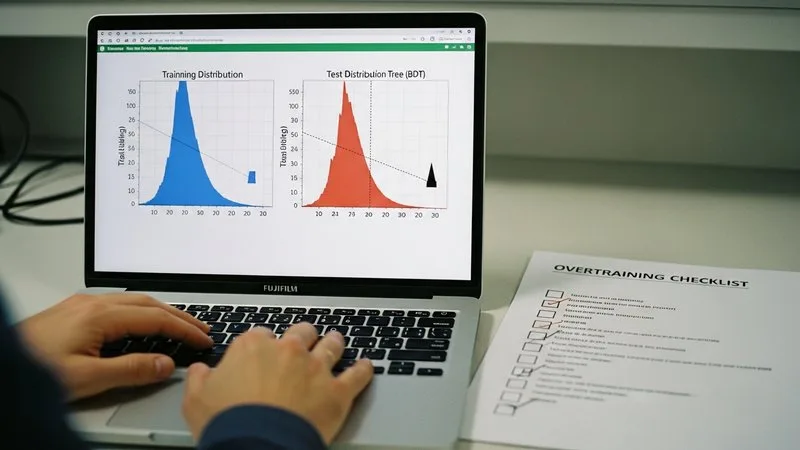
If you have ever trained a BDT, seen it perform beautifully on your training sample, and then watched that performance quietly collapse on new data, you have already met overtraining. It feels like a technical glitch, but it is actually a conceptual one: the model has memorized your training events rather than learned the underlying physics. The good news is that overtraining a BDT is predictable, detectable, and preventable with a handful of habits you can adopt today.
Why Overtraining Happens in Decision Trees
A Boosted Decision Tree grows by repeatedly splitting your data on observable boundaries. Given enough trees, enough depth, or too few training events, the ensemble will start fitting statistical fluctuations in your training sample the same way a polynomial of high degree fits noise in a scatter plot. Physicists sometimes call overfitting "fitting the noise" in a chi-square context — overfitting a decision tree is exactly the same thing, just hidden inside a black box you cannot plot directly.
The danger for a physics analysis is subtle. Your training sample and your signal/background samples often share the same underlying Monte Carlo, so an overtrained BDT can inflate your expected sensitivity without any real discriminating power. You will not see it in a simple performance metric unless you deliberately look.
The Train/Test Split: Your First Line of Defence
The standard tool for catching overtraining before it damages your result is the train/test split in physics analyses. The idea is simple:
Step 1 — Divide Your Sample Before You Touch It
Before any training begins, randomly split your available Monte Carlo (and data sidebands, if you are using them for training) into two non-overlapping halves. Reserve one half strictly for training and one half strictly for evaluation. The evaluation half must never influence any model decision, including hyperparameter choices.
A common mistake is to do this split after exploratory work with the full sample. By then you have already introduced information from the test events into your workflow, even unconsciously.
Step 2 — Train on One Half, Score Both
Run your BDT training on the training half. Once training is complete, compute the BDT output score for every event in both halves using the frozen, trained model.
Step 3 — Overlay the Output Distributions
Plot the BDT score distributions for signal and background separately, overlaying training and test samples on the same axes. A well-generalising model will show training and test distributions that sit on top of each other. A BDT overtraining check flagging a problem looks like this: the training distribution is systematically narrower or pushed to more extreme scores than the test distribution. Signal events cluster closer to 1, background events cluster closer to 0, and the gap between the two is artificially wide.
You can support this visual inspection with a KS test or a simple chi-square between the training and test histograms, but the overlay plot alone is usually diagnostic enough to act on.
How to Stop Overtraining Before It Starts
Once you can see overtraining, the next question is how to prevent it. The knobs available to you are:
Reduce model complexity. Fewer trees or shallower trees (lower maximum depth) leave the ensemble less room to memorise fluctuations. Start with conservative defaults and increase complexity only if you verify on the test sample that performance genuinely improves.
Require a minimum number of events per leaf. Most BDT implementations expose a minimum-leaf-size parameter. Increasing it forces splits to be based on statistically meaningful subsets of your training data rather than handfuls of events.
Use regularisation or shrinkage. A lower learning rate (sometimes called shrinkage) means each individual tree contributes less to the final ensemble. Combined with more trees, this tends to produce smoother, more generalisable decision boundaries.
Add more training events. The most reliable fix is more Monte Carlo, because overtraining is fundamentally a sample-size problem. If you cannot generate more events, consider reducing the number of input features to avoid the curse of dimensionality — fewer observables means less surface area for the model to overfit.
Cross-validation. If your sample is small enough that a single train/test split wastes too much data, k-fold cross-validation rotates through multiple held-out subsets. This costs more compute but gives you a more stable picture of generalisation.
Integrating the Check Into Your Workflow
The overtraining check is not a one-time step at the end of your analysis — it should happen every time you retrain, every time you change your feature set, and every time you adjust a hyperparameter. Build the overlay plot into your training script so it is produced automatically.
If you want a structured path through BDT training, hyperparameter tuning, and the broader landscape of supervised learning for HEP, the complete course walks through each of these steps with physics-analysis examples. You can also start with the free Module 1 to get a feel for how ML concepts map onto the statistics workflow you already use.
For related context on choosing input features and understanding what your BDT is actually learning, see the articles on feature selection for HEP classifiers and interpreting BDT output scores in the blog.
The one-line takeaway: always reserve a held-out test sample before training, overlay the score distributions when training is done, and treat any visible gap between training and test as a systematic you must close before unblinding.
Want to go deeper?
Machine Learning for High Energy Physics: The Complete Course takes you from first principles to a defensible result in 6 structured modules. $97, 30-day guarantee.
See the course →Not ready yet? Grab Module 1 free →