Cut-Based vs Multivariate Analysis: When ML Actually Helps
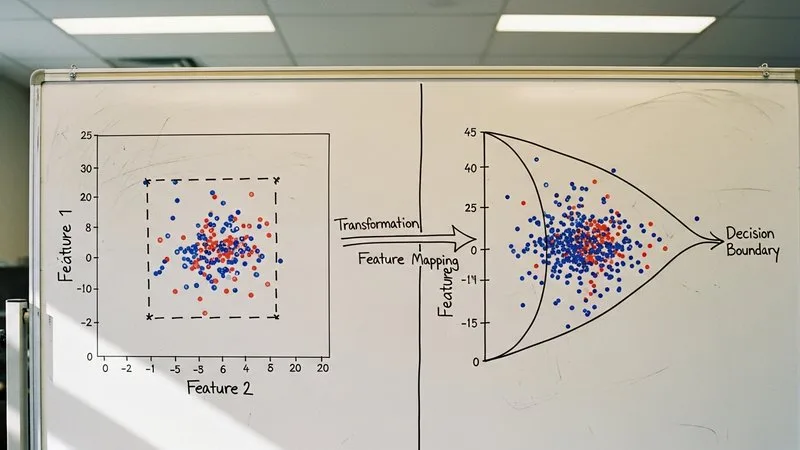
If you have ever felt the quiet frustration of watching a cut-based selection leave signal on the table — knowing intuitively that your variables carry more discriminating power than a sequence of rectangular windows can extract — you are in good company. Most analyses in particle physics start with rectangular cuts for excellent reasons, and most analyses eventually hit a point where they ask: is a multivariate method actually worth adding here? This article gives you a principled way to answer that question.
Why Rectangular Cuts Are a Reasonable Default
A cut-based analysis is transparent. Every selection boundary lives in a space you can draw on a whiteboard, scan by eye, and defend to a collaboration review committee. Systematic uncertainties are straightforward to evaluate because the selection region is explicit. Signal efficiency and background rejection can be quoted for each cut independently, and if something looks wrong you can trace it directly to a single variable.
This transparency is not a weakness — it is a genuine virtue, especially early in an analysis when you are still building trust in your data and simulation.
The limitation appears when your input variables are correlated. If two observables jointly discriminate signal from background — meaning the signal and background populations separate cleanly in the two-dimensional plane but neither variable alone draws a clean boundary — then two independent rectangular cuts will always leave some signal efficiency uncaptured. You are enforcing an axis-aligned boundary in a space where the optimal boundary is diagonal or curved. Every extra correlated variable compounds this loss.
The Core Question: Are Your Variables Correlated?
Before reaching for a boosted decision tree or neural network, check whether correlation is actually present and actually matters for your selection.
Step 1: Plot the 2D distributions
Make two-dimensional scatter plots or histograms of your discriminating variables, overlaid for signal and background. If the signal and background contours are clearly separated along diagonal or curved boundaries — not just along the individual axes — that is the clearest sign that a rectangular cut-based analysis vs multivariate approach is worth considering seriously.
Step 2: Check whether the correlation differs between signal and background
Even if two variables are correlated in both populations, what matters is whether the structure of that correlation differs. If signal forms a tight cluster in a corner of the 2D plane while background is spread across a band, a multivariate classifier can learn that shape. If both populations are correlated in the same way and in the same direction, the gain from going multivariate may be modest.
Step 3: Count your variables
With two or three discriminating variables, you can often do a reasonable job by hand, perhaps by constructing a simple combination or a likelihood ratio in low dimensions. As the number of relevant observables grows — into the range typical of jet substructure or event-level selections with many final-state objects — the volume of phase space that rectangular cuts must partition grows rapidly, and a multivariate analysis in particle physics is usually the more practical path.
When ML Genuinely Helps
A classifier like a BDT (boosted decision tree) approximates the likelihood ratio between your signal and background hypotheses given your input observables. In regions where the variables are weakly correlated and individually powerful, rectangular cuts and a BDT will perform similarly. The BDT earns its complexity when:
- Several variables are moderately correlated and no obvious low-dimensional combination is apparent
- The signal region is compact in a high-dimensional space and hard to tile with rectangular cuts
- You are working in a regime where small gains in signal efficiency translate to meaningful improvements in discovery sensitivity
Understanding this connection between classifiers and likelihood ratios is one of the conceptual foundations covered in the full HEP ML course. If you want to build that intuition from the ground up, free Module 1 is a good starting point.
What You Give Up, and How to Manage It
The added complexity of rectangular cuts vs BDT comparisons cuts both ways. A multivariate classifier is harder to interpret, harder to validate, and can be sensitive to mismodeling in your simulation in subtle, non-local ways. If the BDT learns a combination of variables that is poorly described by your Monte Carlo, your background estimate will be wrong in ways that are harder to catch than a mismodeled single variable.
Practical mitigations: validate the classifier output distribution in a data control region before unblinding, monitor the individual input variable distributions in high and low BDT-score sidebands, and treat the classifier output as one more observable that needs the same scrutiny you would apply to any other.
A deeper treatment of validation strategies — including how to check for overtraining, which is the multivariate equivalent of overfitting a chi-square to limited Monte Carlo — is available in the complete course curriculum.
Putting It Together
The practical decision tree looks like this: start with rectangular cuts, examine whether your variables are correlated in a way that costs you signal, and move to a multivariate method only when the correlation structure and the number of variables make that cost tangible and the added complexity manageable. Multivariate analysis particle physics workflows are most powerful when you treat the classifier as a hypothesis-testing tool and validate it with the same rigor you bring to everything else.
If your variables are correlated and you have the simulation quality to validate it, a multivariate classifier will almost always outperform rectangular cuts — the question is whether the gain is worth the scrutiny it demands.
References
Roe, B. P., Yang, H.-J., Zhu, J., Liu, Y., Stancu, I., & McGregor, G. (2005). Boosted decision trees as an alternative to artificial neural networks for particle identification. Nuclear Instruments and Methods in Physics Research A, 543, 577-584. arXiv:physics/0408124.
Want to go deeper?
Machine Learning for High Energy Physics: The Complete Course takes you from first principles to a defensible result in 6 structured modules. $97, 30-day guarantee.
See the course →Not ready yet? Grab Module 1 free →