TMVA vs scikit-learn vs XGBoost: Choosing an ML Toolkit for HEP
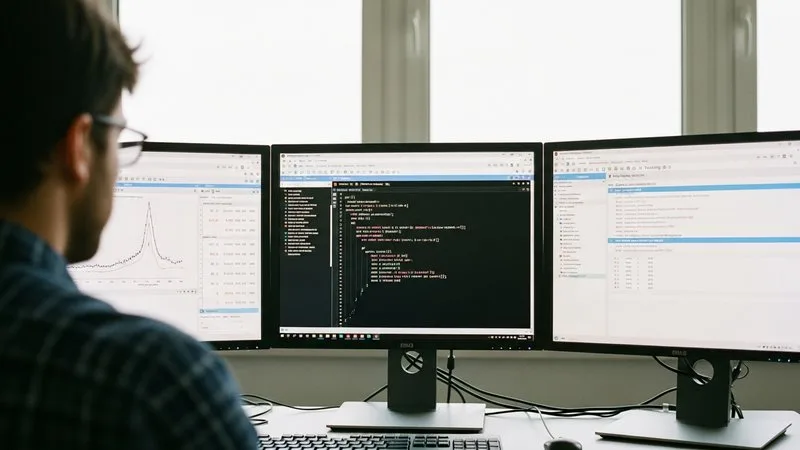
If you have spent any time in a HEP analysis group, you have probably heard three names come up when the conversation turns to classifiers: TMVA, scikit-learn, and XGBoost. Each has genuine strengths, and choosing poorly at the start of a project costs time later. This article lays out the trade-offs plainly so you can make a confident choice before you write a single line of training code.
What Each Toolkit Actually Is
TMVA (Toolkit for Multivariate Analysis) is the toolkit that ships with ROOT. It was designed specifically for particle physics and integrates naturally with the ROOT ecosystem — reading TTrees, writing weight files, and producing the diagnostic plots (overtraining checks, variable rankings, correlation matrices) that reviewers expect to see in an analysis note. If your collaboration already lives inside ROOT, TMVA removes friction.
scikit-learn is the general-purpose Python machine learning library. It follows a consistent, well-documented API and gives you access to a broad zoo of algorithms — decision trees, random forests, SVMs, logistic regression, gradient boosting — all with the same fit / predict interface. Its documentation is unusually good, and the wider Python data science ecosystem (pandas, NumPy, matplotlib) slots in naturally beside it.
XGBoost is a gradient-boosted decision tree library that has become a standard workhorse in competitive ML. In particle physics, boosted decision trees (BDTs) were already the dominant non-neural approach, and XGBoost offers a particularly well-engineered implementation with built-in regularisation, handling of missing values, and straightforward GPU support. It is available as a standalone library with a scikit-learn-compatible interface, so it pairs with the rest of the Python stack.
How to Decide Where to Start
Step 1 — Audit your data format
If your signal and background samples live in ROOT files and you have no existing pipeline for converting them to NumPy arrays or pandas DataFrames, starting with TMVA costs you the least setup work. The moment you have a working Python-based data loading step (uproot is the common choice), scikit-learn and XGBoost become equally accessible.
Step 2 — Consider what your collaboration expects
Some collaborations have internal frameworks built around TMVA weight files and expect a specific output format for the MVA response. Others have moved to Python-based workflows. Ask your local analysis contact before committing. Switching toolkits mid-analysis because the framework expects a different output format is an avoidable headache.
Step 3 — Think about your algorithm choice
If your analysis calls for a BDT — and many do — XGBoost particle physics analyses consistently demonstrate that XGBoost's implementation is faster to train, easier to regularise, and better supported long-term than TMVA's internal BDT. If you want to explore a range of algorithms quickly and compare them, the scikit-learn uniform API makes that straightforward. If you need a simple, robust cut-based or fisher discriminant approach and you are already in ROOT, TMVA is perfectly adequate.
Step 4 — Factor in your own learning curve
If you are newer to machine learning, the scikit-learn documentation and tutorial ecosystem is exceptionally mature. Concepts like cross-validation, hyperparameter search, and pipeline construction are explained thoroughly, and mistakes are caught by clear error messages. TMVA's documentation assumes more ROOT familiarity and can be harder to debug. Our full HEP ML course builds fluency in both the conceptual foundations and the Python toolkit ecosystem, which helps close that gap quickly.
The TMVA Alternative Question
Physicists often ask whether there is a sensible TMVA alternative that preserves the physics-friendly diagnostics while gaining modern flexibility. The practical answer most groups land on is: use uproot or ROOT's RDataFrame to handle file I/O, then hand off to scikit-learn or XGBoost for training. You recover the efficiency-versus-purity curves (ROC curves) and overtraining checks through scikit-learn's own utilities. This hybrid approach is now common enough that you will find examples in most active experiments.
Practical Considerations You Should Not Skip
- Reproducibility: All three toolkits support random seed setting. Fix your seeds from day one.
- Overtraining checks: The equivalent of a chi-square goodness-of-fit comparison between training and test distributions is easy in all three. Do not skip it. The free Module 1 of our course walks through why overtraining matters and how to detect it early.
- Feature engineering: Whether you call them input variables or features, investing time in well-motivated observables almost always matters more than toolkit choice. A thoughtful observable selection beats a poorly chosen one regardless of which library trains the model.
- Hyperparameter tuning: scikit-learn's
GridSearchCVandRandomizedSearchCVmake this systematic. TMVA's equivalent is less flexible. XGBoost integrates cleanly with both.
If you want a structured path through these decisions — including hands-on exercises in the Python ML stack applied to realistic HEP datasets — the complete HEP ML course is designed exactly for analysts in your position.
Takeaway: Start with scikit-learn and XGBoost if you can read your data into Python; reach for TMVA only when the ROOT integration saves you more time than its constraints cost you.
References
Hoecker, A., Speckmayer, P., Stelzer, J., Therhaag, J., von Toerne, E., & Voss, H. (2007). TMVA - Toolkit for Multivariate Data Analysis. PoS ACAT, 040. arXiv:physics/0703039.
Chen, T., & Guestrin, C. (2016). XGBoost: A Scalable Tree Boosting System. Proceedings of the 22nd ACM SIGKDD International Conference on Knowledge Discovery and Data Mining. arXiv:1603.02754.
Want to go deeper?
Machine Learning for High Energy Physics: The Complete Course takes you from first principles to a defensible result in 6 structured modules. $97, 30-day guarantee.
See the course →Not ready yet? Grab Module 1 free →