What Is Machine Learning? A Physicist's Plain-English Guide
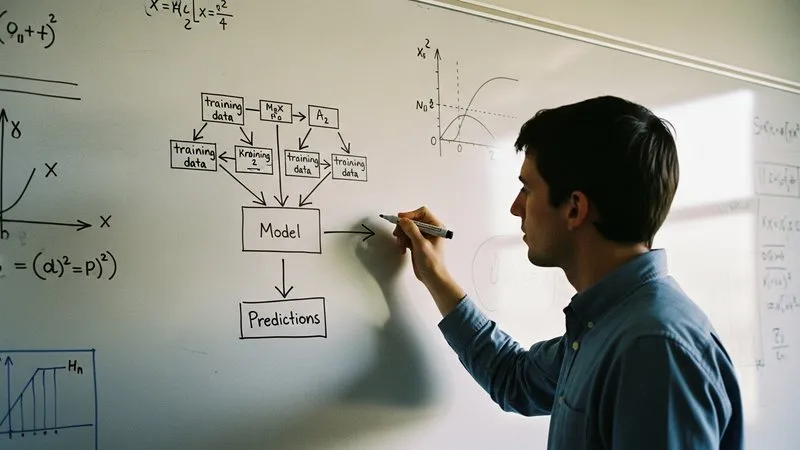
If you've ever felt a knot in your stomach when someone mentions machine learning at a collaboration meeting, you're in excellent company. Many physicists who can comfortably discuss renormalization or detector systematics go quiet when the conversation turns to machine learning. The good news is that you already understand the core ideas — you've just been using different words for them.
You Already Know the Hard Part
Think about the last time you calibrated a detector. You fed in a source with known properties, watched what the detector produced, and tuned the response until the output matched what you expected. What you were really doing was teaching a system to connect inputs to outputs using examples where you already knew the right answer.
That is, in plain terms, what machine learning is. You show a system a large collection of examples — each example paired with a label telling the system what the right answer is — and the system adjusts its internal settings until it can reproduce those correct answers reliably. No magic, no sentience. Just calibration at a much larger scale.
Signal, Background, and the Separation Problem
Here is where machine learning for physicists starts to feel genuinely familiar. Imagine you are trying to find a rare decay buried in an enormous pile of background events. You have simulation that tells you what signal events look like and what background events look like — maybe in dozens of measured quantities simultaneously. A human analyst might draw cuts in two or three of those quantities and call it a day. But the signal and background might be separated most cleanly by a subtle combination of many quantities at once, a combination no one would think to draw by hand.
Machine learning is essentially a tool for finding that combination automatically. You hand the system a large set of simulated events, each labelled as signal or background, and it learns which patterns consistently distinguish one from the other. When you then show it a real collision event, it returns something like a score reflecting how signal-like the event appears. You can think of this as a sophisticated, multidimensional cut — one derived from the data rather than from intuition alone.
The reason machine learning particle physics has grown so quickly is not that physicists were doing anything conceptually wrong before. It is simply that modern detectors produce far more information per event than a human can efficiently use by hand, and machine learning is good at reading patterns across many variables at once.
The Overfitting Problem — You've Seen This Before
Here is the moment where machine learning explained for physics audiences really clicks. Think of a fit that goes beautifully through every point in your training sample. The chi-squared looks wonderful. You feel satisfied. Then you apply it to a fresh, independent dataset and it falls apart completely.
Physicists call this a fit that has learnt the noise rather than the signal. In machine learning the same problem has a different name, but the physics is identical: the system has memorised the specific examples it was shown instead of learning the underlying pattern. It cannot generalise.
The standard remedy will also feel familiar. Just as you would validate a calibration on an independent run of data you held back deliberately, machine learning practitioners split their labelled examples into separate groups. One group is used for learning, another is kept completely separate for testing. If the system performs well on the held-back group, you have some confidence it has learnt something real. If performance collapses on the test group, you know you have the machine-learning version of an overfit curve.
This is one of the topics covered in depth in the complete HEP ML course, where every concept is grounded in detector physics and collision data you will immediately recognise.
Simulation Is Your Training Ground
Most of the time in particle physics, machine learning is trained on simulation rather than on real collision data. This is both a strength and a source of systematic uncertainty — exactly the kind of systematic uncertainty you already think about every day. If your simulation does not perfectly describe reality, the patterns the system learns from simulation may not transfer cleanly to real data. Checking and correcting for this is an active area of research, and it is genuinely important.
You can explore how physicists handle this challenge in practice through our free introductory module, which walks through a concrete analysis example step by step.
Where to Go From Here
Machine learning is not a replacement for physical understanding. It is a tool, like a fit or a cut, that works best when you understand what it is doing and why. Physicists who engage with it thoughtfully — bringing their instincts about signal, background, and systematics to bear — tend to use it more effectively than those who treat it as a black box.
The full HEP ML program is designed specifically for physicists at exactly this starting point: curious, capable, and looking for a way in that respects what you already know.
Machine learning for physicists is, at its heart, calibration with more variables and better bookkeeping — and you have been doing calibration your whole career.
Want to go deeper?
Machine Learning for High Energy Physics: The Complete Course takes you from first principles to a defensible result in 6 structured modules. $97, 30-day guarantee.
See the course →Not ready yet? Grab Module 1 free →