When Your Fit Memorizes the Noise: A Warning Every Physicist Knows
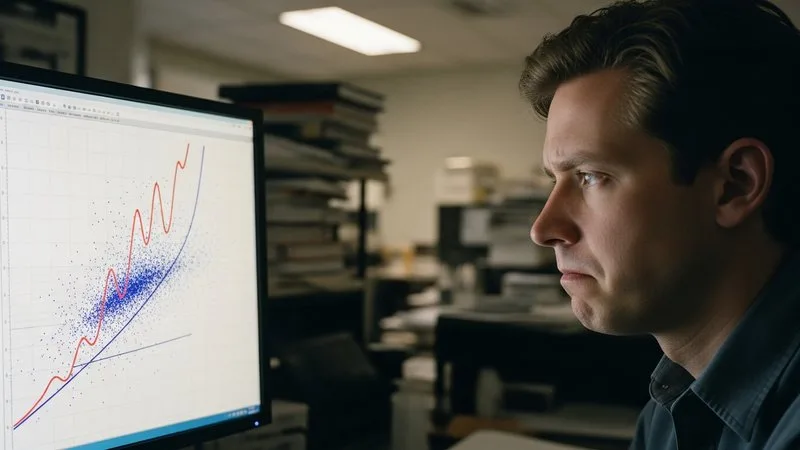
If you have ever spent a long afternoon coaxing a fit until it traced every wiggle in your invariant-mass distribution — only to watch it collapse the moment you switched to a fresh run — you already understand the central danger of machine learning. The technical term is overfitting in machine learning physics, and it is one of the first things we cover in the complete course because it catches people off guard in a very familiar disguise.
The Fit That Knows Too Much
Imagine you are fitting a background shape in a sideb and region. You add polynomial terms, one by one, until the fit looks gorgeous — every little fluctuation is accounted for, and your χ² per degree of freedom is suspiciously close to perfection. Then you apply the same fit to the signal region, or to a second dataset, and it is a disaster. The curve chases ghosts that were just statistical noise in the first sample and has nothing useful to say about the real structure underneath.
That is overfitting, exactly. It is not a machine-learning invention; it is a lesson physicists have been learning the hard way for decades. What machine learning does is give the effect a new costume and a much larger wardrobe to hide in. Instead of adding polynomial terms by hand, a machine-learning model can have thousands of internal adjustments — all tuned automatically — and every single one of those adjustments is an opportunity to chase noise rather than signal.
Why Machine Learning Makes This Easier to Stumble Into
When you fit by hand, you feel each new term you add. You pause, look at the plot, and ask whether the extra wiggle is physical. That natural friction slows you down and often saves you.
When machine learning fails on new data, it is usually because that friction is gone. The model can tune itself far beyond what any human would patiently do by hand, and it does so silently. You hand it your Monte Carlo simulation, it studies the events, and it finds patterns — real ones, yes, but also every quirk of that particular simulation run, every accidental correlation between variables that happened to line up by chance, every trace of the specific beam conditions that week. It has, in effect, memorized the simulation rather than learned physics.
Recognizing the Problem Before It Bites
The warning sign is the same one you know from calibration work: a calibration curve that fits your source runs beautifully but drifts the moment you apply it to collision data. The curve learned your source, not the detector.
Here is how to check for the same problem in a machine-learning model, using nothing but ideas you already have:
Split your sample early — and keep the second half locked away
Take your simulation and divide it into two independent halves before you touch the model at all. Train the model on the first half. Then — and this is the discipline that matters — do not look at the second half again until you are completely done adjusting anything. Think of the second half as fresh collision data from a run you have not analyzed yet. If the model performs well on the first half but poorly on the second, you have your diagnosis: overfitting explained in the starkest possible terms.
Watch for suspiciously perfect performance
If your model separates signal from background so cleanly that it seems too good to be true, treat that the way you would treat a fit with a χ² that is suspiciously low. Perfect is a red flag. Real data have noise; a model that has genuinely learned something will still make some mistakes. A model that makes almost none has probably memorized details that are not physics.
Check whether your model has learned your systematics
This is the physics version of the overfitting warning that most textbooks miss. If your simulation has a known systematic — say, a slightly wrong jet energy scale or an imperfect pile-up description — a model with too much freedom will learn that systematic as if it were signal. When you apply that model to real data, where the systematic is different, it will underperform in ways that are very hard to diagnose. The free Module 1 walks through how to think about this before you ever start training.
Use simplicity as a prior
Just as you would not add a sixth-order polynomial when a second-order one describes the physics, you can constrain how much freedom your machine-learning model has. More freedom is not always better; it is a trade-off between learning real structure and machine learning noise physics right into the model's memory.
The Deeper Lesson
Overfitting machine learning physics is not a pathology unique to machine learning — it is the universal problem of any model that is flexible enough to memorize its training data. Machine learning just makes the problem easier to stumble into and harder to spot without deliberate checks. Everything in the complete course is built around the habit of asking: did this model learn physics, or did it learn my simulation?
If you can keep that question in front of you at every step, you are already thinking like an experienced practitioner.
Want to go deeper?
Machine Learning for High Energy Physics: The Complete Course takes you from first principles to a defensible result in 6 structured modules. $97, 30-day guarantee.
See the course →Not ready yet? Grab Module 1 free →