XGBoost Hyperparameter Tuning for Physics Datasets
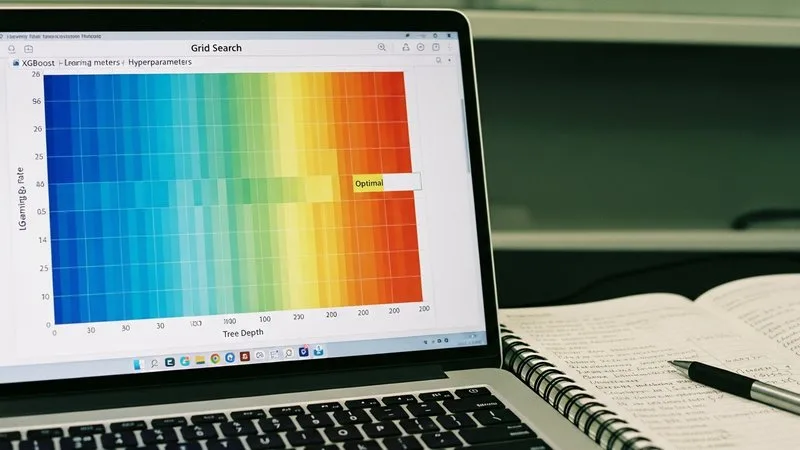
If you've trained your first XGBoost classifier on a physics dataset and watched it memorise the training sample while doing nothing useful on the test set, you're in good company. Hyperparameter tuning feels like turning dials on an unfamiliar detector — there are too many of them, the documentation is written for data scientists rather than physicists, and it's not obvious which ones actually matter. This guide cuts through that. It tells you which knobs move the needle for a physics classifier, what each one physically does to the model, and a sane order to turn them so you don't fool yourself.
Why Physics Datasets Have Their Own Quirks
Particle physics datasets often come with class imbalance (signal is rare), correlated features (observables that share underlying kinematics), and a relatively modest number of features compared to image or text problems. These properties shift which hyperparameters matter most. Regularisation and tree depth tend to dominate; exotic settings matter less. Keep that framing in mind as you go.
The Parameters That Actually Matter
Not all knobs are created equal. For most physics classifiers, these five do the heavy lifting.
max_depth
This is the depth of each individual decision tree. A shallow tree (depth 2–4) makes simple, axis-aligned cuts — roughly what you'd draw by hand in a 2D histogram. A deep tree can capture high-order correlations between observables but is prone to memorising statistical fluctuations in your training sample, the same way fitting a high-degree polynomial to a few data points gives a curve that passes through every point and predicts nothing useful. Start here before touching anything else.
n_estimators and learning_rate
These two are inseparable and should always be tuned together. The learning_rate (also called eta) controls how much each new tree is allowed to correct the previous ensemble. A small learning rate means each tree contributes a tiny correction; you need more trees (n_estimators) to reach the same total model capacity. A large learning rate gets there faster but overshoots and leads to an unstable, overfit model.
Think of it like a gradient descent step size in your parameter fits: too large and you skip over the minimum, too small and you need many more iterations. The practical recipe for XGBoost hyperparameter tuning is to fix learning_rate to something deliberately small and then use early stopping (see below) to find the right n_estimators automatically. This collapses two parameters into one search.
subsample and colsample_bytree
These add randomness. subsample draws a random fraction of your training events for each tree; colsample_bytree draws a random fraction of your features (observables). Both are forms of regularisation — they prevent any single tree from having access to the full dataset and thus reduce variance. In physics terms, they're analogous to jackknife resampling: by training on random subsets, the ensemble becomes less sensitive to any one event or one correlated group of observables.
min_child_weight and gamma
These control when XGBoost is allowed to make a new split. min_child_weight sets a minimum sum of event weights in a leaf node; raising it forces the tree to make only splits that are supported by a meaningful number of events. gamma sets a minimum gain required before a split is accepted at all. Both push against overtraining. For imbalanced datasets — common in new physics searches — min_child_weight is especially useful because rare-signal leaves can otherwise be split on statistical noise.
A Sane Tuning Order
Jumping straight to a grid search over all parameters at once is a mistake. The search space is too large, and correlated parameters interact in ways that make flat grids misleading. Instead, work in stages.
Stage 1 — Fix the learning rate, find n_estimators with early stopping. Set learning_rate small. Enable early stopping with a held-out validation set (not your final test set — treat that like blinded data). XGBoost will stop adding trees when the validation metric stops improving. Record the optimal n_estimators.
Stage 2 — Tune tree structure. With n_estimators fixed, scan max_depth and min_child_weight. These two together define how complex each tree is and how much evidence it requires to make a cut. A coarse grid is fine here.
Stage 3 — Tune randomisation. Scan subsample and colsample_bytree. These interact weakly with tree structure, so doing them after Stage 2 is clean.
Stage 4 — Fine-tune and lower the learning rate. Once you have good structural parameters, optionally lower learning_rate further and re-run early stopping. This often recovers a modest improvement in generalisation.
For a deeper grounding in why this ordering works — and how BDTs fit into the broader toolkit of physics classifiers — the full HEP ML course walks through the decision-tree family from first principles. You can also get started with the free Module 1 before committing.
Don't Tune Yourself Into Overtraining
The biggest trap in XGBoost physics tuning isn't using the wrong parameters — it's optimising hyperparameters directly on the test set. Use a proper train/validation/test split, or k-fold cross-validation, and keep your test set blind until the very end. Every time you peek at test performance to guide a tuning decision, you leak information and your final ROC curve becomes optimistic.
The ROC AUC — efficiency versus background rejection, or equivalently signal efficiency versus inverse false-positive rate — is a clean metric for this because it's threshold-independent. Use it on your validation set during tuning, not your test set.
For more on building a robust evaluation pipeline, the HEP ML course covers the full workflow from feature engineering through model selection.
Takeaway: For physics classifiers, tune max_depth and tree regularisation first, use early stopping to resolve the learning_rate–n_estimators trade-off automatically, and keep your test set blind throughout — that discipline matters as much as any individual hyperparameter choice.
References
Chen, T., & Guestrin, C. (2016). XGBoost: A Scalable Tree Boosting System. Proceedings of the 22nd ACM SIGKDD International Conference on Knowledge Discovery and Data Mining. arXiv:1603.02754.
Want to go deeper?
Machine Learning for High Energy Physics: The Complete Course takes you from first principles to a defensible result in 6 structured modules. $97, 30-day guarantee.
See the course →Not ready yet? Grab Module 1 free →